LLC vs. S-Corp vs. C-Corp: How to Choose the Right Entity for Your Startup
Which business entity should you choose? If you plan to raise outside investment, the answer is almost always a Delaware C-Corp. Here's why, and what happens if you choose wrong.
LLC vs. S-Corp vs. C-Corp: How to Choose the Right Entity for Your Startup
A note before we start: This is not legal advice. Entity structure involves tax law, securities law, and state-specific rules that depend on your situation. This article reflects my experience as someone who has worked with many different companies over the year. It is my high-level opinion about how entity choice affects your ability to raise capital and your relationship with investors. There is real nuance here, and you should talk to a lawyer before incorporating.
If you don’t have a startup attorney yet, these are good places to start:
- Wilson Sonsini - the standard for venture-backed startup legal work
- Clerky - automated Delaware C-Corp incorporation designed by startup lawyers
- Stripe Atlas - formation, banking, and legal templates in one package
- LegalZoom - accessible option for LLC and small business formation
- Your state bar association’s referral service for a local business attorney
The two questions worth answering before you choose an entity:
- Will this business raise outside capital?
- And if so, what relationship will I have with those investors?
Everything below follows from those questions.
The Short Version
Your entity structure isn’t a legal formality. It determines how you raise money, who can invest, how you’re taxed, and how much it costs to change later. Most founders either overthink this (spending weeks researching when the answer is straightforward) or underthink it (defaulting to an LLC because it’s cheapest, then discovering it blocks them from raising equity).
Here’s my opinion of the decision in one paragraph: If you plan to raise outside equity, incorporate as a Delaware C-Corp. If you’re building a lifestyle business, a services firm, or something you plan to own long-term without outside investors, an LLC or S-Corp is likely the right choice. Everything below is the detail behind that statement. Again, I am hedging here because every company is a snowflake and I am not a lawyer.
How Each Entity Structure Works
LLC (Limited Liability Company)
An LLC is the most flexible entity structure. It provides liability protection, pass-through taxation, and minimal formality requirements.
- Liability protection: Your personal assets are separate from the business
- Pass-through taxation: Profits and losses flow to your personal tax return
- Low overhead: No board of directors or annual meetings are required in most states
Good for: Services businesses, consulting firms, real estate holding companies, side projects, and businesses where you’re the primary owner.
Bad for: raising equity investment. Most VCs and many angels will not invest in an LLC. LLCs issue membership interests, not stock. They can’t issue stock options to employees. The tax treatment (K-1s to all members) creates accounting complexity for investors. Converting an LLC to a C-Corp after taking investment is expensive and painful.
Stripe Atlas, which has helped incorporate thousands of startups, says it directly: if you plan to raise venture capital, don’t form an LLC.
S-Corp (S Corporation)
An S-Corp is a tax election, not a separate entity type. You form either an LLC or a corporation, then elect S-Corp tax status with the IRS. Profits pass through to shareholders and avoid double taxation. The cost: strict eligibility rules.
S-Corp restrictions:
- Maximum 100 shareholders
- All shareholders must be US citizens or residents
- Can only issue one class of stock
- No corporate or partnership shareholders (VCs organized as funds can’t invest)
Good for: Small businesses with steady profits where the owner wants to minimize self-employment tax. Common for profitable services firms, medical practices, and small businesses with 1-5 owners.
Bad for: fundraising from institutional investors. The single class of stock restriction means you can’t issue preferred stock, the standard instrument for venture investment. The US-only shareholder rule eliminates international investors entirely.
C-Corp (C Corporation)
A C-Corp is the standard structure for venture-backed companies. It can issue multiple classes of stock (common for founders, preferred for investors), has no shareholder limits, and accepts investment from any entity type.
The trade-off: Double taxation. The corporation pays corporate tax on profits, and shareholders pay personal tax on dividends. For a profitable company distributing cash to owner-operators, this is a real cost. For a startup reinvesting all revenue into growth, it’s irrelevant.
Why Delaware? Nearly all venture-backed companies incorporate in Delaware, regardless of where they operate. Delaware’s Court of Chancery has decades of case law around corporate governance, investor rights, and M&A transactions. Investors and their lawyers know Delaware law. Using another state creates legal friction that can slow your raise. The annual franchise tax and registered agent fee run ~$400-$500/year for most startups.
Good for: Any company that plans to raise equity investment, issue stock options to employees, or be acquired.
Bad for: Small businesses that are profitable, don’t plan to raise, and want to minimize tax complexity.
How to Choose: LLC vs. S-Corp vs. C-Corp
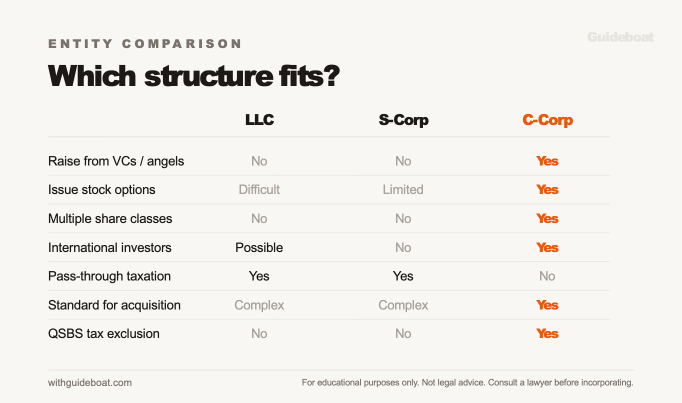
| Question | LLC | S-Corp | C-Corp |
|---|---|---|---|
| Are you raising from VCs or angels? | No | No | Yes |
| Do you want to issue stock options? | Difficult | Limited | Yes |
| Are you profitable and distributing cash? | Yes (tax efficient) | Yes (tax efficient) | No (double taxed) |
| Do you have international investors? | Possible | No | Yes |
| Is it you or 1-2 partners? | Yes | Yes | Works but more overhead |
| Do you plan to be acquired? | Possible but complex | Possible but complex | Yes (standard) |
What Happens When You Pick the Wrong Entity
Converting between entity types is an additional expense and use of time. Here’s what each path looks like.
LLC to C-Corp is the most common conversion and also the most painful. It requires creating the new corporation and valuing the LLC’s assets. You’ll transfer all contracts, issue stock to former LLC members, file new tax returns, and likely trigger a taxable event. Budget $10-20K in legal fees and 4-8 weeks.
S-Corp to C-Corp is simpler (revoke the S election) but requires timing around the tax year.
C-Corp to LLC almost never happens. Once you’re a C-Corp, you’re staying one.
What Your Lawyer Might Not Tell You
If you are going to form a C-Corp, then an LLC is not cheaper in the long run. The upfront cost is lower, but if you convert to raise money, you’ll spend more in legal fees than you saved. For companies that might raise capital someday, starting as a C-Corp is often cheaper overall.
You don’t need to incorporate before you have product-market fit. If you’re exploring an idea, don’t first spend money on incorporation. Wait until you’re ready to take money (from customers, investors, or grants) or hire people, or have to sign a legal contract with a customer.
QSBS (Qualified Small Business Stock) matters. C-Corp stock held for more than 5 years may qualify for up to $10M in federal capital gains tax exclusion under Section 1202. LLCs and S-Corps don’t qualify. In practice: if a founder sells their C-Corp for $5M after five years, the entire gain could be tax-free. The same exit structured as an LLC would owe capital gains on the full amount. If you’re building something you plan to sell, the QSBS benefit alone can justify the C-Corp structure.
Your state matters too. You’ll incorporate in Delaware (for the legal framework) but register to do business in your home state. You’ll pay franchise tax in both states. Factor this into your annual costs.
The Bottom Line
If you’re raising venture capital or angel investment: Delaware C-Corp. Full stop.
If you’re building a business you plan to own and operate without outside equity investors: LLC with an S-Corp election once you’re profitable enough for the tax savings to matter.
If you’re not sure: talk to a startup lawyer before you incorporate. A 30-minute conversation can save you thousands in conversion costs later.
Entity structure is easy to get right early and expensive to fix later. Don’t let a $500 incorporation savings cost you $20,000 in conversion fees two years from now.
Further Reading
- Carta: Incorporation Guide - covers entity selection, Delaware formation, and equity setup in depth
- Stripe Atlas: LLC vs. C-Corp - plain-English comparison from the team that’s incorporated thousands of startups
- Y Combinator: Setting Up Your Company - YC’s standard advice for early-stage founders on formation
- Clerky FAQ - practical answers about the incorporation process itself
Need help thinking through how your entity choice affects your fundraising strategy? Understanding entity structure is one of the first things we cover in a fractional CFO engagement. For more on matching your structure to investors, see How to Find Investors for a Small Business.